

Teen Patti and Andar Bahar: Two Live Rounds Compared
A side-by-side look at two live Indian card rounds: the Ante, Play or Fold decisions in dealer Teen Patti, and the reference-card chase in Andar Bahar, with external provider rules labelled clearly.
Teen Patti and Andar Bahar are both card games, yet they ask you to decide at different moments. Teen Patti hands you a choice after you have seen your three cards. Andar Bahar asks you to commit after a single reference card is exposed, then lets the alternating deal run. This piece walks through both rounds using published rules from an external live dealer supplier, so the mechanics you read here match how those named products actually run.
Where the two rounds diverge
Both games use a standard deck and both resolve on card ranks, but the shape of a round is not the same. Teen Patti is a comparison game: your three cards against the dealer’s three cards, with a betting step in the middle. Andar Bahar is a matching game: one card is exposed as a reference, and cards are dealt to two sides until that rank appears again.
That difference changes what you are watching on screen. In Teen Patti the tension sits in your own hand and the dealer’s qualification check. In Andar Bahar the tension sits in the deal itself, as cards alternate between Andar and Bahar and the matching rank stays hidden. Results vary from round to round, and the table rules govern how each round settles.
To see the contrast with a game where you arrange your own cards rather than play the ones dealt to you, the Rummy hand article covers a different card format. Here we stay with the two live rounds themselves.
Teen Patti: Ante, then Play or Fold
The external Evolution Teen Patti variant begins with an Ante bet placed before any cards are dealt. Three cards then go to the player and three to the dealer. After you see your three cards, you choose to Play by matching your Ante or to Fold and lose the Ante. The dealer’s hand must reach Queen High to qualify.
If the dealer does not qualify, your Play bet is returned and the Ante pays 1:1. If the dealer qualifies, the higher hand wins, with a winning Ante and Play each paying 1:1, and a tie returning both. Those are the published terms of that named product, not a universal rule set for every Teen Patti table in India, where social and home variants differ on jokers, ace placement and hand ranking.
Take a hypothetical stake ledger to see the decision in practice. Suppose you place an Ante of 10 units and, after seeing your cards, choose to Play another 10 units. If the dealer does not qualify, your Play of 10 returns and the Ante pays 1:1, so you receive 30 units back in total including your stakes, a net of 10 units on 20 staked. If the dealer qualifies and your hand is higher, you receive 40 units back in total, a net of 20. If the dealer qualifies and beats you, you lose both stakes, 20 units. If you had folded instead, you would lose the Ante of 10 units. These are illustrative units only, and any optional side bets are excluded from the ledger.
The timing matters: the Ante goes down before the deal, the three cards are revealed, then you choose Play or Fold, and only then does the dealer reveal and the qualification check run. There is no point at which you see your cards before placing the Ante.
Andar Bahar: the reference card leads
The external Evolution Super Andar Bahar product runs on a different rhythm. A single card is exposed first as the joker or reference card. Main betting closes after that card is shown, and then the deal begins, alternating between the Andar side and the Bahar side until a card matching the reference rank appears. The main bet predicts which side will produce the match.
Because the reference card is visible before main betting closes, the round gives you one piece of information up front: the rank you are waiting for. Everything after that is the deal. Cards alternate Andar, Bahar, Andar, Bahar, and the side that draws the first matching rank settles the main bet.
Consider a hypothetical reference card of the seven of clubs. You now know that another seven of any suit ends the round. If you back Andar, you are hoping the first seven falls on an Andar position; if you back Bahar, you are hoping it falls on a Bahar position. The published product does not promise that either side is due, and results vary from round to round. Treat any claim that a side is overdue with suspicion.
One practical note on the video feed: a dropped frame or a lagging stream does not settle anything. The official round record is what counts, so if the video stutters, wait for the result to register rather than assuming an outcome from what you think you saw.
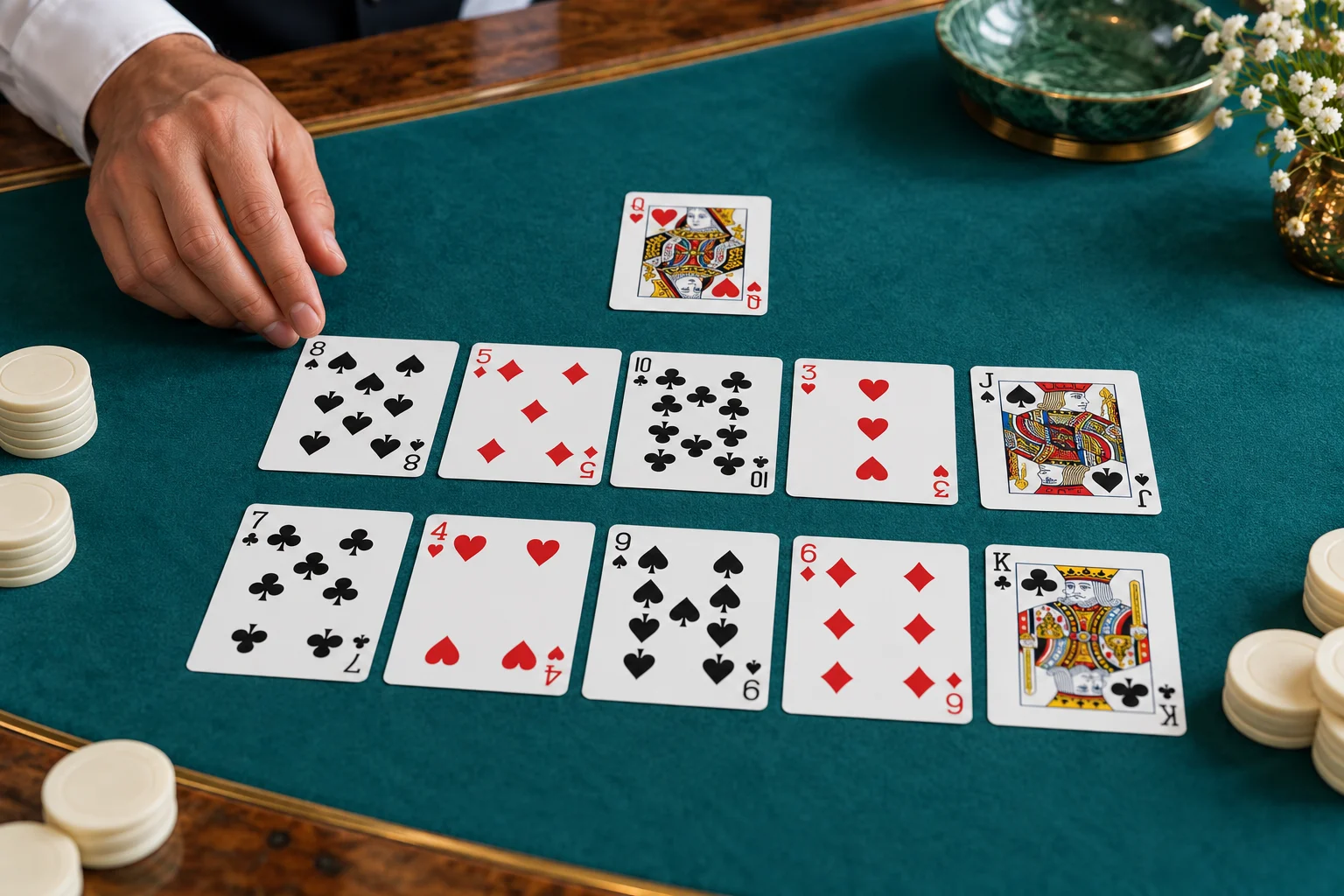
Reading the two rounds side by side
Set the rounds next to each other and the decision points line up neatly.
- When you commit: Teen Patti takes your Ante before the deal, then your Play or Fold decision after you see your three cards. Andar Bahar takes your main bet after the reference card is shown but before the alternating deal starts.
- What settles the round: Teen Patti compares two three-card hands and checks dealer qualification at Queen High. Andar Bahar waits for a rank match on one of two sides.
- What you can see before betting: In Teen Patti you know nothing of your hand before the Ante; you see your three cards only before the Play or Fold step. In Andar Bahar you know the reference rank before main betting closes but not the deal.
- Where the suspense sits: Teen Patti builds around the dealer’s qualification and the hand comparison. Andar Bahar builds around the alternating deal and the moment the matching rank appears.
The two formats differ in decision timing and resolution: dealer Teen Patti compares three-card hands after the Ante and Play or Fold steps, while Andar Bahar ends when the reference rank appears on one side.
Optional side bets in each round
Both named products carry optional side bets that resolve separately from the main wager. In Evolution Teen Patti these are Pair Plus and the 6 Card Bonus. Pair Plus looks at your three-card hand for a pair or better. The 6 Card Bonus forms the best five-card poker hand from your three cards plus the dealer’s three. Each is a separate bet with its own paytable, and each can lose while your main hand wins, or the reverse.
Evolution Super Andar Bahar offers ten optional card-count ranges, from 1-5 through 46-49. These are supplier side-bet features: you are betting on how many cards will be dealt before the match appears, not on which side wins. The ranges are five cards wide for most of the list, with the final range of 46-49 covering four cards, and the paytables reflect that.
Side bets are best treated as entertainment add-ons. They are evaluated separately from the main wager and should not be used to chase losses from the main bet.
What the table screen tells you
Live tables display the essentials: the betting window, the current stakes, the dealt cards and the result. In Teen Patti, watch for the dealer’s qualification check after the hands are revealed. In Andar Bahar, watch the reference card and then the alternating deal positions.
Screens may lag, and the exact fields shown can vary by table. Only the operator’s official result or round record determines settlement, so if the display stutters, wait for the official record rather than assuming an outcome.
Stake limits, table limits and any promotional terms attached to live play are set by the operator and shown at the table. Players must be 18 or older, and T&C apply.
If slots are more your pace, the slot features article covers how those rounds work, including the difference between promotional spins and in-game features.
Source notes
Rules for the Teen Patti and Super Andar Bahar examples above are drawn from the official Evolution product pages: Evolution Teen Patti and Evolution Super Andar Bahar. These are external supplier products used here as illustrative examples; their mechanics should not be read as universal rules for every Teen Patti or Andar Bahar table, and no claim is made that these products are available on Jeet Boost.