
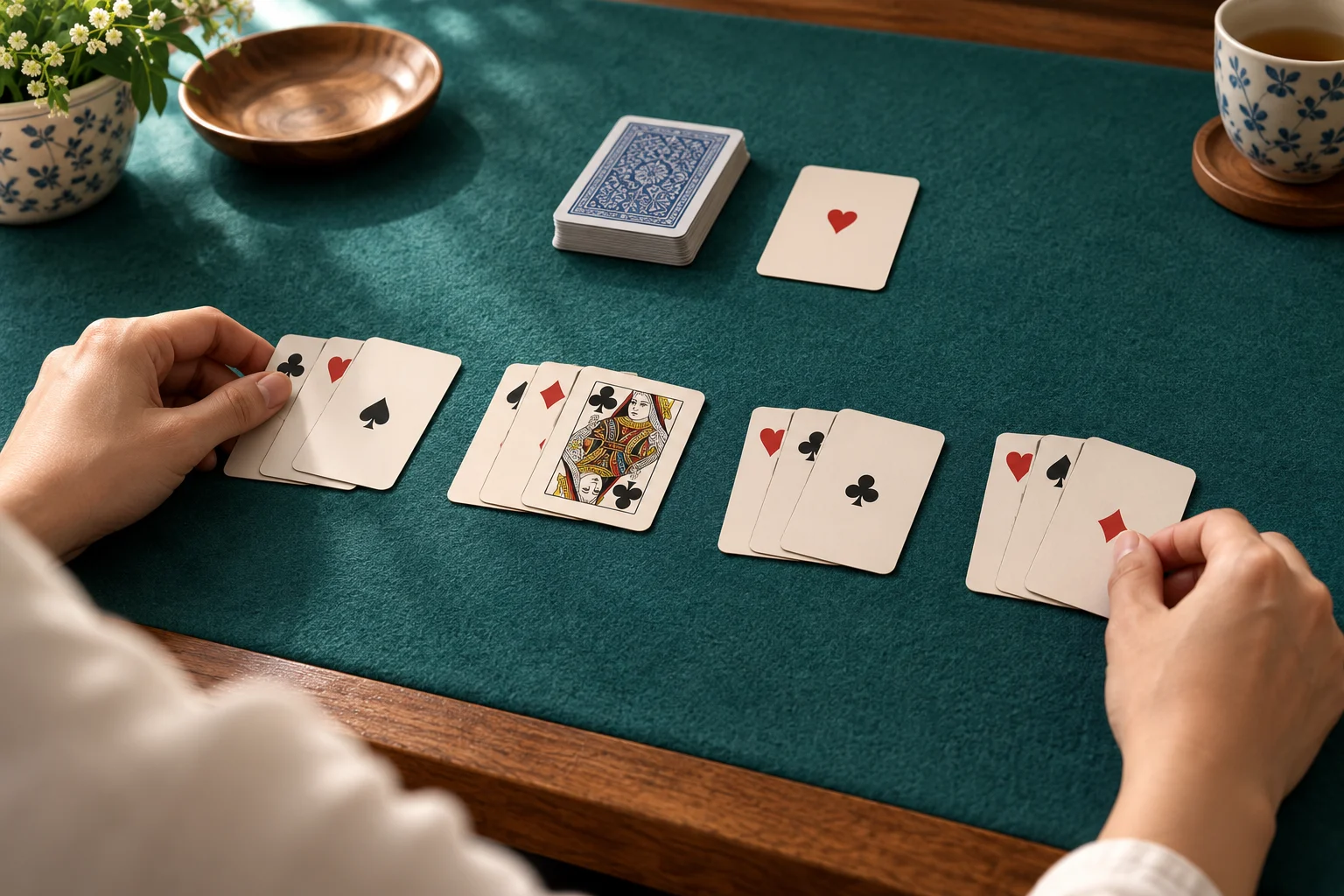
Rummy Hand Workshop: Building a Complete Thirteen-Card Hand
A turn-by-turn workshop on how a Rummy hand is arranged, with one explicit before-and-after draw, a fully grouped Indian 13-card example, and notes on where variant rules diverge.
Thirteen cards sit on the table, and the question is how they should be arranged. In a Rummy hand, that arrangement is not fixed at the deal. It changes with every turn, because a player draws one card and then discards one, and each of those two actions can shift the shape of the whole hand. This workshop follows that movement in concrete terms: a starting spread, one explicit draw, one discard, and the grouped hand that results.
One Family, Many Rulebooks
Rummy is a broad family rather than a single fixed game. Across the family, the shared building blocks are matched sets of three or four cards of equal rank and same-suit runs of three or more consecutive cards. Beyond that, versions diverge. Some allow melding and laying off cards onto existing groups, which means a hand can shrink during play and hand size is not universally constant. Others, including the Indian 13-card format used in this workshop, keep a fixed hand and ask the player to arrange it into valid groups by the end of the turn.
That distinction matters when reading any rule set. A rule that feels obvious in one Rummy variant may be absent or reversed in another. Ace placement, the role of jokers, scoring values and the exact declaration requirement all shift between versions. The thirteen-card turn-end size described below belongs specifically to the labelled Indian example; it should not be carried across to every Rummy family as though the number were universal.
A Worked Thirteen-Card Example
Consider a hypothetical Indian 13-card hand at the end of a normal turn. The player has drawn and then discarded, leaving thirteen cards in hand. The cards are grouped as follows:
- Hearts 4-5-6 — a three-card pure sequence in one suit.
- Spades 8-9-10-J — a four-card pure sequence in one suit.
- Queens of clubs, diamonds and hearts — a three-card set of equal rank.
- Twos of spades, hearts and clubs — a second three-card set of equal rank.
Count the cards: three plus four plus three plus three equals thirteen. Every card is distinct, no card appears twice, and no joker is used anywhere in this example. The hand contains two pure sequences and two sets, which satisfies the common Indian Rummy declaration condition of at least two sequences with at least one of them pure. It is a clean illustration precisely because nothing is borrowed from a wild card to make it work.
The turn that produced it
Before that turn, the same player held thirteen cards in a looser spread: hearts 4-5-6, spades 8-9-10, queens of clubs, diamonds and hearts, twos of spades, hearts and clubs, and a loose seven of diamonds. That is three plus three plus three plus three plus one, which again totals thirteen. The hearts run was already pure at three cards. The spades run was pure but stopped at the ten. Both sets were complete at three cards each. The seven of diamonds belonged to no group and matched no rank already held.
The player then drew the jack of spades from the stock, taking the hand to fourteen cards. That jack extended the spades run from 8-9-10 to 8-9-10-J, turning a three-card sequence into a four-card one. With fourteen cards in hand, one discard was required to return to thirteen. The player discarded the loose seven of diamonds, which had no place in any group. The hand returned to thirteen cards, now arranged as hearts 4-5-6, spades 8-9-10-J, the three queens and the three twos.
Notice what changed and what did not. The hearts run stayed at three. Both sets stayed at three. The spades group grew by one card, and the loose card left. The total stayed at thirteen because one card came in and one went out. This is a description of a single hypothetical turn, not a recommendation about which card to draw or discard; different players may value the same spread differently.
How the Hand Reaches Completion
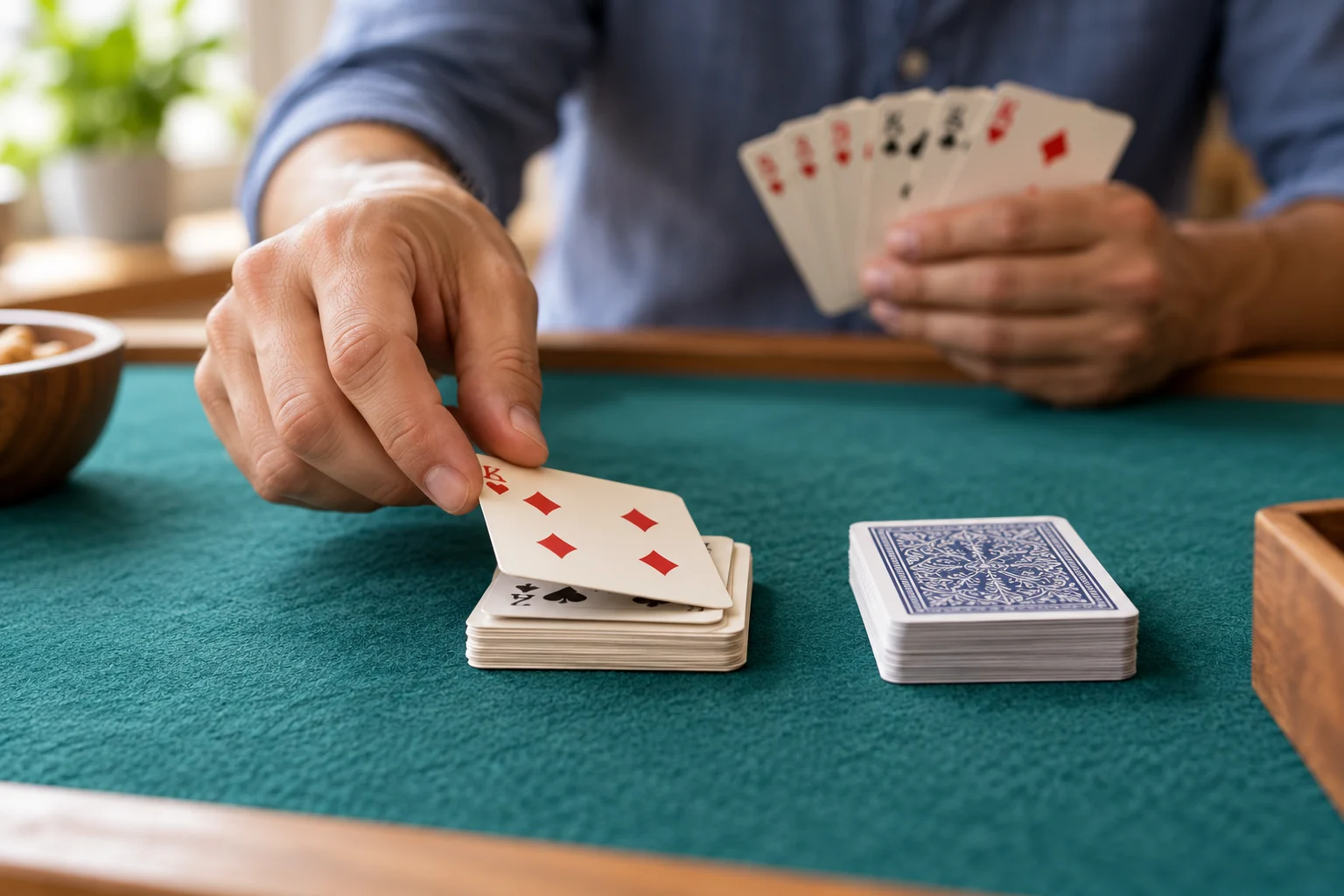
The finished arrangement above did not appear at once. In a typical Indian 13-card turn, the player begins by drawing one card, either from the closed stock or from the open discard pile, and then discards one card to return to thirteen. Each turn is therefore a small trade: one card in, one card out, with the hand’s shape adjusted slightly each time.
Early in a hand, the useful question is which groups are forming. Two hearts cards of ranks four and six, sitting in the same suit, leave a gap that the five of hearts would fill. Two queens suggest a third might be reachable. The player holds these possibilities loosely while discarding cards that serve no group and show little promise of serving one.
Later, the question changes. Once two sequences and a set are largely in place, the remaining cards must either slot into an existing group or form a new one. A card that fits nowhere becomes a candidate for discard even if it looks attractive in isolation. The example hand reflects that discipline: the spades run absorbed a fourth card, the hearts run settled at three, and the two sets each stopped at three because a fourth queen or two was not needed to reach thirteen.
At declaration, the complete hand is assessed against the variant’s group and sequence requirements. The player must show valid groups, meet the sequence requirement, and satisfy whatever joker and point conditions the variant imposes. A hand that looks tidy on the table can still be invalid if a pure sequence is missing or a group is misdeclared.
Valid and invalid groupings side by side
The difference between a legal group and a near-miss is worth seeing directly. Take hearts 4, hearts 5 and the six of diamonds. Those three cards sit in rank order, but they are not a same-suit sequence, because the six is a diamond while the four and five are hearts. A run requires consecutive ranks within one suit. The same three ranks with the six of hearts would form a pure sequence; with a diamond six, they do not.
Now compare two incomplete pairs with a completed set. Holding the queen of clubs and the queen of diamonds is a pair, not a set, because a set needs three cards of equal rank. Adding the queen of hearts completes it: queens of clubs, diamonds and hearts are three cards of the same rank across different suits, which is a valid set. The suits differ, and that is fine for a set; it is the rank that must match.
The same logic separates a pair of twos from the finished group. Two twos are a pair awaiting a third. The twos of spades, hearts and clubs together are a set of three. Meanwhile hearts 4-5-6 is a sequence because the ranks are consecutive and the suit is constant. These contrasts are the everyday grammar of Rummy grouping, and they explain why the worked hand above is valid at every group.
Where Jokers Change the Arithmetic
The worked example deliberately uses no jokers, which keeps the counting transparent. In practice, jokers are often the difference between a hand that completes and one that stalls. A joker can stand in for a missing card in a sequence or set, but whether it may do so, how many may be used, and how a joker-assisted group is treated at scoring all depend on the variant. Those conditions are not universal, so any joker-dependent grouping is provisional until the specific rulebook is confirmed.
One boundary is worth stating plainly: a pure sequence is pure because it uses natural cards of one suit in consecutive order. A joker substituting for a card does not make that group pure. In the supplied complete hand there are no jokers at all, and both sequences, hearts 4-5-6 and spades 8-9-10-J, are pure on their natural cards alone.
Points, Aces and the Small Print
Scoring is another area where versions part ways. Point values for face cards and aces, penalties for ungrouped cards, and the treatment of a wrong declaration all depend on the rule set in use. Ace placement is a common stumbling block: whether an ace sits low before the two, high after the king, or both, changes which runs are legal.
None of this is settled by the illustrative hand alone. The example shows how thirteen cards can be organised into two pure sequences and two sets; it does not fix the scoring table, the joker policy or the declaration penalty for any particular operator or variant. Players should read the rules of the format they are actually playing and treat this workshop as a way to understand grouping logic, not as a substitute rulebook.
From Card Groups to Other Table Formats
Rummy centres on arranging a hand across turns, while the live card examples below follow a dealer-led round. Dealt-card games such as Teen Patti and Andar Bahar ask players to read a small set of cards and decide before the deal resolves, which is a different rhythm from arranging thirteen cards across turns. Reel games work differently again, and the slot features walkthrough covers how symbols, multipliers and free spins are structured there.
Rules references are educational and do not establish any Jeet Boost Rummy variant or live inventory: Indian Rummy rules reference and Bicycle Rummy rules. The thirteen-card hands above are illustrative constructions. 18+, T&C apply.